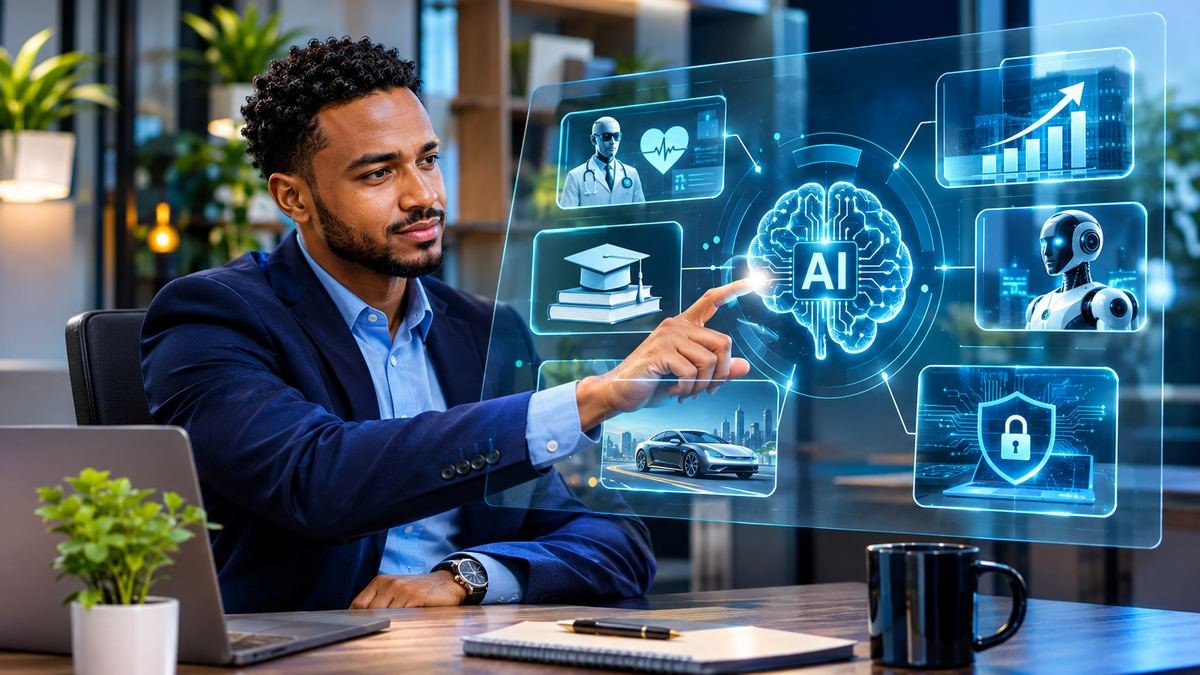
Artificial Intelligence (AI) is changing the world in ways that were difficult to imagine just a few years ago. From business automation and healthcare to education, transportation, finance, and entertainment, AI is transforming how people work, communicate, learn, and solve problems.
In 2026, artificial intelligence is no longer limited to experimental technology or large technology companies. Businesses, entrepreneurs, students, professionals, and individuals are increasingly using AI-powered tools in their everyday activities.
AI assistants can help write content, analyze information, generate images, translate languages, support software development, and automate repetitive tasks. Meanwhile, more advanced AI systems are beginning to perform complex tasks with less human intervention.
These developments are creating exciting opportunities, but they also raise important questions about privacy, cybersecurity, employment, accuracy, and responsible technology use.
Understanding artificial intelligence in 2026 is essential for anyone who wants to keep up with technological developments and prepare for the future.
In this guide, we explore 10 major ways AI is transforming the world, examine its benefits and challenges, and explain how individuals and businesses can use this technology effectively.
1. AI Is Transforming Business and Workplace Productivity

Artificial intelligence is changing how businesses operate by helping organizations complete tasks more efficiently and make better use of information.
Companies are using AI tools to analyze documents, prepare reports, organize customer information, support employees, and automate repetitive activities.
For small businesses, AI can make certain professional tools more accessible without requiring large teams or expensive infrastructure.
Important business applications include:
- Automating administrative tasks.
- Analyzing business performance.
- Preparing reports and presentations.
- Improving customer service.
- Managing business workflows.
- Supporting marketing campaigns.
- Assisting with market research.
How AI will change the future of business:
Businesses may spend less time on repetitive activities and more time on strategy, customer relationships, and innovation.
According to Stanford’s 2026 AI Index, 88% of surveyed organizations reported using AI in 2025, while generative AI was being used in at least one business function by 70%. These figures demonstrate how widely AI has entered organizational operations.
Stanford HAI+1
Practical tip: Start by identifying three repetitive tasks in your business that AI could help improve. Test suitable tools and measure whether they actually save time or money.
2. AI Agents Are Changing How Work Gets Done

One of the important developments in artificial intelligence is the growth of AI agents.
Unlike traditional AI assistants that mainly respond to individual instructions, AI agents can work toward specific goals by completing multiple steps, using tools, and interacting with digital systems.
For example, an AI agent could help a business research potential customers, organize information, prepare an email draft, and update a business database.
Important applications include:
- Customer support automation.
- Business research.
- Software development assistance.
- Appointment management.
- Document processing.
- Sales workflow support.
- Data organization.
How AI agents will change the future:
AI agents could help organizations coordinate complex digital workflows and reduce the amount of manual work required for certain processes.
However, they are not completely reliable or suitable for every task. Human supervision is particularly important when agents access sensitive information or perform actions involving money and business decisions.
Practical tip: Begin with simple tasks that are easy to review. Give AI agents limited permissions and monitor their activities.
Gartner’s 2026 research highlights the difference between enthusiasm for AI agents and their actual deployment maturity. Many organizations are still experimenting with narrowly defined applications.
Gartner+1
3. AI Is Improving Healthcare and Medical Research

Healthcare is another area where artificial intelligence is creating important opportunities.
Medical professionals and researchers can use AI systems to examine medical images, organize health information, support research, and identify patterns in large datasets.
AI can also help researchers investigate potential treatments and improve certain administrative processes.
Important healthcare applications include:
- Medical image analysis.
- AI-assisted disease screening.
- Medical research.
- Drug discovery.
- Hospital administration.
- Health information management.
- Clinical decision support.
How AI will change the future of healthcare:
AI could help healthcare professionals process information more efficiently and support earlier identification of certain medical conditions.
For example, AI-assisted imaging systems can help qualified professionals examine medical scans and identify areas that may require further investigation.
However, AI does not replace medical professionals. Clinical decisions must involve appropriate medical expertise, patient information, and professional judgment.
Practical tip: Healthcare organizations should use properly evaluated medical AI systems and protect patient information through strong privacy and security practices.
The World Bank’s 2026 development report identifies medical screening as one area where AI is already helping improve access to expertise.
worldbank.org
4. AI Is Transforming Education and Online Learning

Artificial intelligence is changing how students learn, teachers prepare lessons, and educational institutions deliver information.
AI-powered educational tools can explain difficult subjects, generate practice questions, translate learning materials, and provide personalized study assistance.
Students can use these tools to understand unfamiliar topics and organize their learning activities.
Important educational applications include:
- AI tutoring assistants.
- Personalized learning materials.
- Automated practice exercises.
- Language translation.
- Educational content creation.
- Study planning.
- Teacher preparation tools.
How AI will change the future of education:
Learning may become more flexible and personalized. Students in different locations could access additional educational support without depending entirely on traditional classroom resources.
Teachers can also use AI to save time preparing certain educational materials.
However, students must still develop independent thinking, research abilities, creativity, and problem-solving skills.
Practical tip: Use AI as a learning assistant rather than allowing it to complete all your assignments. Always verify important information and understand the material yourself.
The World Bank highlights AI’s potential to help teachers prepare better lessons and expand access to educational expertise.
worldbank.org
5. AI Is Revolutionizing Content Creation and Digital Marketing

Content creation is becoming faster and more accessible through artificial intelligence.
Businesses, bloggers, marketers, and creators can use AI tools to develop ideas, organize information, prepare drafts, generate images, and support video production.
Digital marketing is also changing because AI can help analyze audiences, improve campaign planning, and identify content opportunities.
Important applications include:
- Blog and article drafting.
- Social media content planning.
- AI-assisted image creation.
- Video editing.
- Advertising copywriting.
- Email marketing.
- SEO research.
- Audience analysis.
How AI will change the future of content creation:
Individuals and small businesses can produce more digital content with fewer resources.
For example, a small business owner can use AI to prepare a weekly social media content calendar, draft promotional messages, and organize marketing ideas.
However, automatically generated content should be reviewed for accuracy, originality, usefulness, and quality.
Practical tip: Use AI to support your creativity, not replace it. Add your own knowledge, experience, examples, and unique perspective to every important publication.
6. AI Is Accelerating Software Development and Scientific Research

Artificial intelligence is changing how software developers write, test, understand, and maintain computer programs.
AI coding assistants can suggest code, explain programming concepts, identify certain errors, and help developers create software more efficiently.
Researchers can also use AI to examine large datasets, investigate scientific questions, and explore possible solutions to complex problems.
Important applications include:
- AI coding assistants.
- Software testing support.
- Code documentation.
- Data analysis.
- Scientific simulations.
- Research assistance.
- Mathematical problem-solving.
- Technical documentation.
How AI will change the future:
Software development may become more accessible to people with different levels of technical experience.
Experienced developers can use AI to accelerate certain activities, while beginners can use it to understand programming concepts.
However, generated code still requires testing, security reviews, and human understanding.
Practical tip: Learn the fundamentals of programming even when using AI coding tools. Understanding how software works helps you identify errors and build reliable applications.
Stanford’s 2026 AI Index reports measurable productivity improvements in certain structured tasks, including software development, while also highlighting that results vary by activity.
Stanford HAI
7. AI Is Transforming Banking, Finance, and Digital Payments

Financial institutions are using artificial intelligence to analyze transactions, identify unusual activity, support customer service, and improve certain financial processes.
AI can examine large amounts of financial information and identify patterns that might be difficult to detect manually.
Important financial applications include:
- Fraud detection.
- Transaction monitoring.
- Customer support.
- Financial forecasting.
- Risk analysis.
- Automated document processing.
- Financial data analysis.
How AI will change the future of finance:
AI could help financial organizations improve operational efficiency and identify suspicious transactions more quickly.
Small businesses may also benefit from AI-assisted bookkeeping, financial reporting, and expense management.
However, financial AI systems can make mistakes and should not be trusted blindly with important investment or lending decisions.
Practical tip: Use trusted financial software, protect account information, and always verify financial calculations before making important decisions.
8. AI Is Changing Transportation and Manufacturing

Artificial intelligence is helping transportation and manufacturing companies improve operational planning, equipment monitoring, and production processes.
In manufacturing, AI-powered systems can analyze sensor information and identify signs of potential equipment problems.
In transportation, AI can support route planning, traffic analysis, driver assistance, and vehicle monitoring.
Important applications include:
- Predictive equipment maintenance.
- Intelligent production systems.
- Traffic management.
- Route optimization.
- Warehouse automation.
- Driver assistance technologies.
- Supply chain management.
How AI will change the future:
Manufacturers may be able to reduce equipment downtime and improve production planning.
Transportation companies can use AI to organize routes, monitor operations, and improve certain aspects of logistics.
Autonomous vehicles are another important area of research and development, although their capabilities and availability differ significantly across locations.
Practical tip: Businesses should identify specific operational problems before investing in expensive AI systems or robotics.
9. AI Is Supporting Agriculture and Food Production

Agriculture is essential to food production, employment, and economic development. Artificial intelligence is creating opportunities to improve how farmers monitor crops, manage resources, and make agricultural decisions.
AI-powered tools can analyze satellite images, weather information, soil data, and crop conditions.
These technologies can help farmers identify certain problems and make more informed decisions.
Important agricultural applications include:
- Crop monitoring.
- Agricultural weather analysis.
- Pest and disease detection.
- Smart irrigation.
- Soil information analysis.
- Farm management systems.
- Agricultural drone technology.
How AI will change the future of agriculture:
Farmers may gain access to better information about crop conditions, weather risks, and resource management.
For developing countries, affordable AI services that work through mobile phones and simple communication systems could be especially valuable.
Practical tip: Agricultural businesses should select tools that match local farming conditions, available connectivity, language requirements, and operating costs.
The World Bank’s 2026 report identifies improved weather forecasting for farmers as one example of AI’s potential development benefits.
worldbank.org
10. AI Is Transforming Communication and Everyday Life

Artificial intelligence is becoming part of everyday activities through smartphones, computers, search engines, translation tools, and digital assistants.
People can use AI to organize schedules, summarize documents, translate languages, search for information, and complete everyday tasks.
AI is also making communication more accessible through speech recognition and language-processing technologies.
Important everyday applications include:
- AI-powered search.
- Voice assistants.
- Language translation.
- Smart home systems.
- Personalized recommendations.
- Document summarization.
- Navigation assistance.
- Accessibility tools.
How AI will change the future:
Digital services may become more personalized and easier to use. People who previously faced language or accessibility barriers could gain additional ways to communicate and access information.
For example, AI translation can help people communicate across different languages, although translations still require review when accuracy is critical.
Practical tip: Use AI assistants to save time, but avoid sharing passwords, confidential documents, or unnecessary personal information.
Benefits of Artificial Intelligence in 2026
Artificial intelligence offers several benefits to individuals, businesses, and organizations.
Here are some of the most important advantages:
| Benefit | How It Helps |
|---|---|
| Increased Productivity | Automates repetitive activities |
| Faster Research | Processes large amounts of information |
| Better Customer Service | Supports automated customer assistance |
| Cost Efficiency | Can reduce certain operational expenses |
| Improved Accessibility | Supports translation and communication |
| Personalization | Provides more relevant experiences |
| Innovation | Helps develop new products and services |
| Decision Support | Identifies patterns in available data |
These benefits depend on how AI is implemented, the quality of information available, and the specific task being performed.
Challenges and Risks of Artificial Intelligence

Although artificial intelligence offers significant opportunities, it also creates challenges that individuals and organizations must understand.
1. Job Displacement
AI can automate certain tasks previously performed by people. Some occupations may change significantly, requiring workers to develop new skills.
2. Data Privacy
AI applications may process sensitive information. Businesses must protect customer data and understand how their technology providers use information.
3. Misinformation
AI can generate convincing but inaccurate information, images, audio, and videos. Users must verify important content before sharing it.
4. Cybersecurity Threats
AI can be misused to create more convincing phishing messages, impersonations, and automated cyberattacks.
5. Biased Results
AI systems can produce unfair or inaccurate results when their training information or design contains biases.
6. Overdependence on Technology
Depending too heavily on AI may weaken independent thinking and reduce opportunities to develop important skills.
7. Lack of Human Judgment
AI does not always understand context, emotions, or the consequences of its recommendations.
The International AI Safety Report 2026 highlights concerns involving misinformation, cybersecurity, employment, human autonomy, and the reliability of advanced AI systems.
International AI Safety Report+1
Important advice: Treat AI as a tool that supports human intelligence, not a replacement for human responsibility.
How Businesses and Individuals Can Prepare for the AI Future

Artificial intelligence is developing rapidly, and learning how to use it effectively can create valuable opportunities.
Here are eight practical ways to prepare:
- Learn AI Fundamentals: Understand what AI can and cannot do.
- Explore AI Tools: Experiment with useful applications for writing, research, design, and productivity.
- Develop Digital Skills: Improve your computer skills, data literacy, and online communication.
- Protect Personal Information: Learn about cybersecurity, privacy, and safe AI usage.
- Improve Critical Thinking: Verify AI-generated information instead of accepting everything automatically.
- Adapt Your Business: Identify tasks that could benefit from responsible automation.
- Continue Learning: Follow technology developments and take relevant online courses.
- Maintain Human Creativity: Develop communication, leadership, problem-solving, and creative skills.
AI Opportunities for Developing Countries
Artificial intelligence could create particularly valuable opportunities in developing economies.
For example, AI-powered services could support:
- Agricultural information and weather forecasting.
- Educational assistance and language translation.
- Small business management.
- Healthcare screening support.
- Digital entrepreneurship.
- Local-language information services.
For countries such as Somalia, practical opportunities worth exploring include AI-supported educational platforms, Somali-language digital services, agricultural information tools, and affordable business automation.
However, reliable electricity, internet connectivity, digital skills, local-language support, and affordable access remain important considerations.
The World Bank’s World Development Report 2026 emphasizes that developing economies can benefit from adapting existing AI technologies to local languages, institutions, and development needs rather than building expensive AI infrastructure from scratch.
worldbank.org
Frequently Asked Questions (FAQs)
1. What is artificial intelligence in 2026?
Artificial intelligence in 2026 refers to technologies that enable computer systems to perform tasks involving language, image recognition, reasoning, prediction, automation, and decision support.
2. How is AI changing the world?
AI is transforming business operations, healthcare, education, transportation, finance, manufacturing, agriculture, communication, and entertainment.
3. What are the most popular uses of AI in 2026?
Common applications include AI assistants, content generation, data analysis, customer support, software development, image generation, translation, and workflow automation.
4. Will artificial intelligence replace human workers?
AI may replace or automate certain tasks, but it can also create new job opportunities. The impact depends on the industry, occupation, and how organizations adopt the technology.
5. Can beginners learn artificial intelligence?
Yes. Beginners can start with basic AI concepts and gradually learn how to use AI applications for writing, research, productivity, and business activities.
6. How can small businesses benefit from AI?
Small businesses can use AI for marketing, customer support, research, content creation, bookkeeping assistance, and repetitive administrative tasks.
7. Is artificial intelligence safe to use?
AI can be useful, but users should understand its limitations. Protect private information, verify important answers, and maintain human oversight for important decisions.
8. What is the difference between generative AI and AI agents?
Generative AI creates content such as text, images, audio, and code. AI agents can use AI capabilities and connected tools to complete sequences of tasks toward a defined objective.
9. Which industries will benefit most from AI?
Industries with significant opportunities include healthcare, education, finance, manufacturing, agriculture, transportation, technology, and digital marketing.
10. What skills will be important in the AI future?
AI literacy, critical thinking, communication, creativity, data analysis, cybersecurity awareness, problem-solving, and adaptability will be valuable skills.
Conclusion: Artificial Intelligence Is Shaping the Future
Artificial intelligence is becoming one of the most influential technologies of our time. Its impact can already be seen in businesses, hospitals, schools, financial institutions, factories, farms, and everyday digital services.
The ten areas discussed in this guide demonstrate how artificial intelligence in 2026 is creating new opportunities while changing traditional ways of working and communicating.
However, AI is not a perfect technology. Challenges involving privacy, cybersecurity, misinformation, employment, and reliability must be addressed responsibly.
For individuals, the best approach is to understand AI, develop relevant digital skills, and learn how to use intelligent tools effectively.
For businesses, the opportunity lies in applying AI to real problems, improving customer experiences, and making operations more efficient.